To understand how malathion and parathion affect the body, we must understand how the nervous system works normally.
How do neurons communicate normally?
Acetylcholine is a neurotransmitter.1 A neurotransmitter is a chemical messenger which allows neurons to communicate with one another, and with other cells in the body.1 Acetylcholine is released when a nerve impulse happens, and it can bind to the different types of receptors: nicotinic and muscarinic receptors.1,2
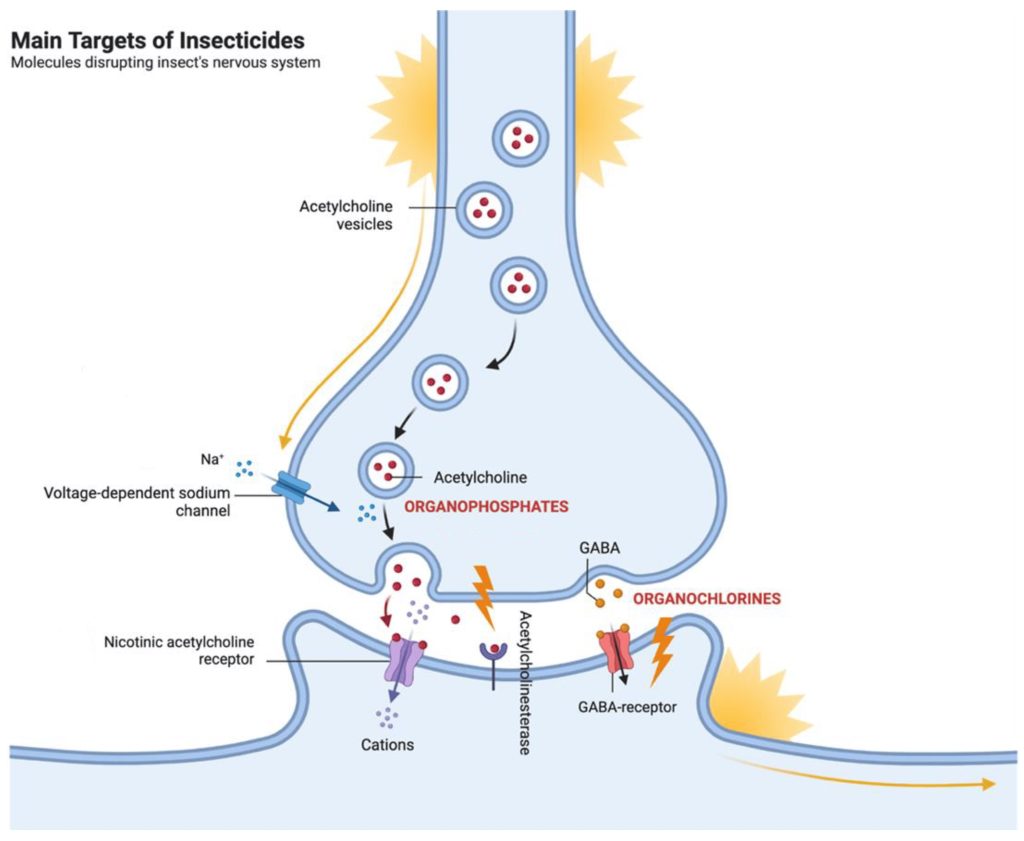
Once the chemical message has been received, acetylcholine binds to its specific acetylcholinesterase (AChE) enzyme, and is broken down so that no more of the chemical message is sent.1,2
How does malathion/parathion affect the communication between neurons?
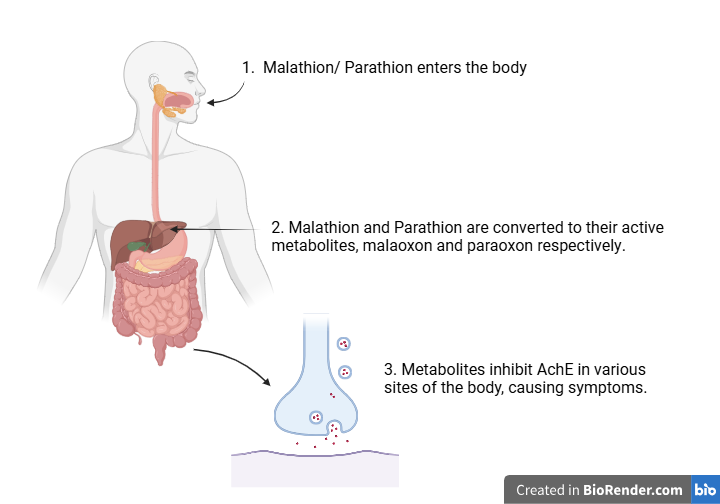
Malathion/parathion can enter the body via inhalation, dermal or oral exposure.4,5
After exposure, malathion is broken down to its active form, malaoxon, and parathion is also converted to its active form, paraoxon.4,5
The insecticides bind to the acetylcholinesterase binding site, preventing the breakdown of acetylcholine at the neuromuscular junction.3 This can happen at various levels within the body.4,5,6
There are 3 categories of poisoning that can happen when AChE is inhibited: muscarinic, nicotinic, and central.3
Muscarinic Poisoning
When the AChE in smooth muscle and glands becomes inhibited, this may result in symptoms such as salivation, teary eyes, pin-point pupils, mucus in the lungs, diarrhoea, and a bradycardia.3
Nicotinic Poisoning
When AChE in the skeletal muscles and clusters of nerve cells are inhibited, this may result in symptoms such as as tachycardia, hypertension, pallor, and fasciculations.3
Central Nervous System Poisoning
When AChE inhibition happens in the central nervous system, this may result in symptoms such as restlessness, anxiety, headaches, confusion, tremors, and lethargy, and in more serious cases seizures and breathing difficulties.3
Malathion 0.5% is commonly used in headlice treatments, so how can you stay safe whilst using this?
- Malathion kills headlice after 10 minutes of application, however some brands instruct you to keep the product on your head for up to 12 hours, increasing the amount of malathion absorbed through the scalp.7 To reduce this, keep the product on the scalp for no longer than 30 minutes – it will still be effective.7 When rinsing off the product, choose to shower over bathing as sitting in bathwater can increase absorption of malathion through other parts of your body.8
- Alternatively, you could opt for non-insecticidal treatments such as Isopropyl myristate or Dimeticone solution, as they have been shown to be effective in treating headlice as well.8
- This is encouraged as studies have provided evidence for malathion causing developmental neurotoxicity (damage to the growing brains of children).8,9 Malathion can impact growing brains, because there is a lower amount of AChE activity in children.9
References
- Sam C., Bordoni B. Physiology, Acetylcholine [Internet].Treasure Island (FL): StatPearls Publishing; 2023 [Cited: 12th November 2024]. Available from: https://www.ncbi.nlm.nih.gov/books/NBK557825/
- Pohanka M. Acetylcholinesterase inhibitors: A Patent Review (2008 – present). Expert Opinion on Therapeutic Patents [Internet]. 2012 Jul 6 [Cited: 12th November 2024];22(8):871–86. Available from: https://www.tandfonline.com/doi/full/10.1517/13543776.2012.701620?needAccess=true
- Araújo M.F., Castanheira E.M. S, Sousa S.F. The Buzz on Insecticides: A Review of Uses, Molecular Structures, Targets, Adverse Effects, and Alternatives. Molecules [Internet]. 2023 Apr 21 [Cited: 28th October 2024];28(8):3641. Available from: https://www.mdpi.com/1420-3049/28/8/3641
- U.S. DEPARTMENT OF HEALTH AND HUMAN SERVICES Public Health Service Agency for Toxic Substances and Disease Registry. Toxicological Profile for Malathion [Internet]. wwwn.cdc.gov. ATSDR; 2003 [Cited: 1st November 2024]. Available from: https://www.atsdr.cdc.gov/ToxProfiles/tp154.pdf
- U.S. DEPARTMENT OF HEALTH AND HUMAN SERVICES Agency for Toxic Substances and Disease Registry . Toxicological Profile for Parathion [Internet]. Atlanta, Georgia : ATSDR; 2017 Jan [Cited: 1st November 2024]. Available from: https://www.atsdr.cdc.gov/toxprofiles/tp205.pdf
- Badr A.M. Organophosphate Toxicity: Updates of Malathion Potential Toxic Effects in Mammals and Potential Treatments. Environmental Science and Pollution Research [Internet]. 2020 May 13 [Cited 2024 Nov 1];27:26036–57.
- Brand R.M., Charron A.R., Brand R.E. Decreasing Malathion Application Time for Lice Treatment Reduces Transdermal Absorption. International Journal of Pharmaceutics [Internet]. 2005 Sep [Cited: 18th November 2024];301(1-2):48–53. Available from: https://www.sciencedirect.com/science/article/pii/S0378517305003315
- Cummings C., Finlay J.C., MacDonald N.E. Head Lice infestations: a Clinical Update. Paediatrics & Child Health [Internet]. 2018 Feb [Cited: 18th November 2024];23(1):e18–24. Available from: https://academic.oup.com/pch/article/23/1/e18/4860349
- Salama M., Lotfy A., Fathy K., Makar M., El-emam M., El-gamal A., et al. Developmental Neurotoxic Effects of Malathion on 3D Neurosphere System. Applied & Translational Genomics [Internet]. 2015 Dec [Cited: 18th November 2024]; 7:13–8. Available from: https://www.sciencedirect.com/science/article/pii/S2212066115300272