- Malathion
- Parathion
How does it enter the body?
Click the tabs below to see the different routes of exposure for malathion.
- Whilst inhalation can happen in both children and adults, it is more of a concern in children due to their low body weight, because they may absorb more malathion.2
Where does it go?
Once inside the body malathion can move through the blood circulation and reach many organs such as the kidneys, spleen and liver.4 Malathion can also be found in your fat tissue, heart, brain, lungs and muscles.4
How is it broken down?
Once malathion reaches the liver, it is met by a variety of enzymes which can break it down into smaller molecules, that can then be removed.5
The liver enzymes which have been shown to interact with malathion are called P450 enzymes.5 The activity of the specific enzymes is dependent on the amount of malathion that has reached the liver.5
To learn more about the P450 enzymes that are involved in the breakdown of malathion, have a look at this article.
How is it removed from the body?
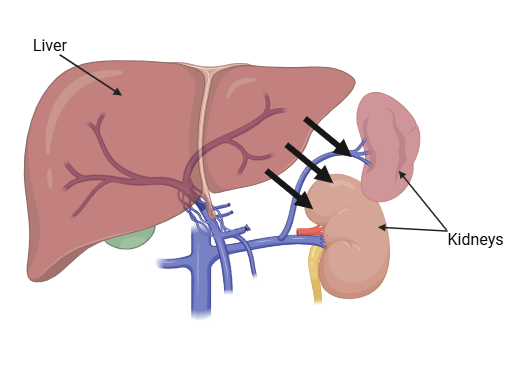
Following breakdown in the liver, the molecules travel to the kidneys where they are filtered and removed from the blood. Over 90% of these molecules are then removed in urine within the first 24 hours.2 Small amounts may also be found in faeces and breath.2
Removal of the majority of malathion breakdown molecules happens within 12-24 hours.6 Small amounts may still be detected in urine after 48 hours.6
The ways in which parathion enters, spreads and interacts with the body are largely similar to those of malathion.
Exposure
Absorption of parathion occurs via the same routes as malathion: orally, through the skin and by inhalation.7
Similarly to malathion, parathion breakdown is carried out by P450 enzymes.2,7 Removal of parathion molecules happens mostly in the urine.7 Also, the removal of breakdown molecules in urine, faeces and breath continues for longer than that of malathion.2,7
What is the difference between malathion and parathion exposure?
At the molecular level, parathion is more lipophilic than malathion, resulting in higher skin absorption. 4,7,8
How quickly it absorbs can be changed depending on temperature, humidity, skin area and skin health.7 It has been shown that skin absorbs between 9-100% of parathion depending on the thickness of the skin where it is applied.7
Digestion in the liver and removal via urine are carried out in the same way for both malathion and parathion.2,7,9
Is parathion more dangerous than malathion?
Parathion poisoning can produce more severe effects than malathion.10 This is because the chemical structure of parathion contains an “aromatic phosphate ester group”, which is difficult for the enzymes in the body to break down.10 Malathion does not have this same structure.10 As a result, malathion is easier for the body to break down and remove, making it less toxic than parathion.10
References
- National Institute of Health. Hazardous Substances Data Bank (HSDB): Malathion [Internet]. PubChem 2024 [Cited: 12th November 2024]. Available from: https://pubchem.ncbi.nlm.nih.gov/source/hsdb/665#section=Absorption-Distribution-and-Excretion-%28Complete%29
- U.S. DEPARTMENT OF HEALTH AND HUMAN SERVICES Public Health Service Agency for Toxic Substances and Disease Registry. Toxicological Profile for Malathion [Internet]. ATSDR; 2003 [Cited: 1st November 2024]. Available from: https://www.atsdr.cdc.gov/ToxProfiles/tp154.pdf
- Reed N.R., Rubin A.L.. Malathion. In: Wexler P, editor. Encyclopedia of Toxicology (Third Edition) [Internet]. California Environmental Protection Agency, Sacramento, CA, USA: Academic Press; 2014. p. 133–7.[Cited: 18th November 2024]. Available from: https://www.sciencedirect.com/science/article/pii/B9780123864543001561?via%3Dihub
- IARC Working Group on the Evaluation of Carcinogenic Risks to Humans. Some Organophosphate Insecticides and Herbicides: Mechanistic and Other Relevant Data. Lyon, France. International Agency for Research on Cancer, 2017. [Cited: 30th October 2024] Available from: https://www.ncbi.nlm.nih.gov/books/NBK436793/
- Buratti F.M., D’Aniello A., Volpe M.T., Meneguz A., Testai E. MALATHION BIOACTIVATION IN THE HUMAN LIVER: THE CONTRIBUTION OF DIFFERENT CYTOCHROME P450 ISOFORMS. Drug Metabolism and Disposition. 2004, 33(3), pp. 295–302. [Cited: 30th October 2024] DOI: https://doi.org/10.1124/dmd.104.001693
- Environmental Protection Agency . ACUTE EXPOSURE GUIDELINE LEVELS (AEGLs) [Internet]. 2009 [Cited: 2nd November 2024 ]. Available from: https://www.epa.gov/sites/default/files/2014-08/documents/malathion_interim_sep_09_v1.pdf
- U.S. DEPARTMENT OF HEALTH AND HUMAN SERVICES Agency for Toxic Substances and Disease Registry . Toxicological Profile for Parathion [Internet]. Atlanta, Georgia : ATSDR; 2017 Jan [Cited: 1st November 2024]. Available from: https://www.atsdr.cdc.gov/toxprofiles/tp205.pdf
- Videira R.A., Antunes-Madeira M.C., Lopes V.I.C.F., Madeira V.M.C. Changes induced by malathion, methylparathion and parathion on membrane lipid physicochemical properties correlate with their toxicity. Biochimica et Biophysica Acta (BBA) – Biomembranes [Internet]. 2001, 1511(2), pp. 360–8. [Cited: 30th October 2024] DOI: https://doi.org/10.1016/S0005-2736(01)00295-4
- National Institute of Health. Hazardous Substances Data Bank (HSDB) : 197 [Internet]. 2024 [Cited: 30th October 2024]. Available from: https://pubchem.ncbi.nlm.nih.gov/source/hsdb/197#section=Metabolism-Pharmacokinetics
- Shibamoto T., Bjeldanes L.F. Pesticide Residues in Foods. 1993. Elsevier; [141-56]. [Cited: 30th October 2024] Available from: https://dx.doi.org/10.1016/B978-0-08-092577-6.50013-7.